
What We Know Now About Three Fatal Crashes.
Four people died in three separate crashes this summer, and in every one, a boat struck a channel marker. Here is what is publicly known about each case, along with the safety lessons every South Jersey boater should take from them.
Important: The operators discussed below have been charged, not convicted. The allegations remain pending, and each defendant is entitled to due process.
The summer at a glance: three crashes, four lives lost
-
- May 25: A center console struck Intracoastal Waterway (ICW) Marker #79 near the Brant Beach Yacht Club in fog. Gunnar Pearson, 28, of Barnegat, died.
-
- July 19: A boat struck a wooden channel marker near Berkeley Township at night. Mya Bella Golabek, 9, and Sigmund Paul Golabek, 7, died.
-
- July 25: A 32-foot center console struck Intracoastal Waterway (ICW) Marker #22 at night. Michael T. Bereheiko, 26, of Green Brook, died.
Three different boats, three different operators, three different nights, and the same basic outline each time: a vessel moving in poor visibility hit a fixed marker it should never have come close to.
Case 1: May 25, the crash we covered in May now has a court case
On May 25, a Trophy 2203CC center console struck Intracoastal Waterway (ICW) Marker #79 near the Brant Beach Yacht Club, around 63rd Street in Brant Beach, at about 5:45 p.m. Gunnar Pearson, 28, of Barnegat, was killed, and five other people were injured.
What is new: The operator was Gunnar’s mother, Jennifer Pearson, 59. On August 19, she was charged with death by vessel, with prosecutors alleging that she operated recklessly while under the influence. Prosecutors said her blood alcohol concentration was between .09 and .12. She told investigators she had consumed two drinks earlier that afternoon.
At a detention hearing on August 21, Judge Kim Rahill released her, noting that she had no prior record and did not pose a risk, but barred her from operating a boat or drinking before driving. Her next court date was September 22. The case remains pending unless a later court update changes that status.
Case 2: July 19, two children and a grandfather’s case
This one hits home for me personally , I’m a grandfather, boater, and my grandkids love the boat!
Shortly after 9 p.m. on July 19, a boat driven by Stephen Schneider, 64, of Bayville, struck a wooden channel marker in Barnegat Bay off Berkeley Township. His grandchildren, Mya Bella Golabek, 9, and her brother Sigmund Paul Golabek, 7, were killed.
Newly released 911 audio from that night captured the aftermath near Channel Marker 39. CPR was attempted, but neither child survived.
What is new: Prosecutors allege that Schneider’s blood alcohol concentration was about 0.16, approximately twice the legal limit. On August 14, he was charged with two counts of reckless vessel homicide, operating under the influence, and reckless operation. On August 19, he was released after the children’s parents asked the judge to release him. He was barred from operating a vessel or a motor vehicle pending a substance-abuse evaluation.
On September 15, prosecutors offered a plea deal involving two consecutive five-year terms, or 10 years total, with 85% to be served before parole. Schneider did not accept the offer that day. His lawyer said discovery was incomplete and autopsy reports were still outstanding, while prosecutors acknowledged that the plea offer may have come early.
This case remains pending and should be checked for a new court update before publication.
Case 3: July 25, a third marker strike six nights later
At about 11 p.m. on July 25, Kevin Wells, 39, of Warren Township, was driving a 32-foot Boston Whaler 320 Outrage with five people aboard when it struck Intracoastal Waterway Marker #22.
Michael T. Bereheiko, 26, of Green Brook, was pronounced dead at a hospital. Two other passengers were seriously injured, and a fourth passenger suffered minor injuries.
What is new: Police said alcohol was involved. On August 28, Wells was charged with vehicular homicide and two counts of assault by auto or vessel, and he was held without bail. The case remains pending unless a later court update changes that status.
What all three crashes have in common
-
- A fixed marker: Every boat hit a navigation marker, the very structure meant to help keep boats safe in the channel.
-
- Poor visibility: Fog played a role in the May crash, while both July crashes happened after dark.
-
- Alcohol allegations: Prosecutors or police allege impairment in all three cases.
-
- Passengers paid the price: In all three crashes, the people killed were passengers.
A boat moving faster than its operator can see may not leave enough time to recognize, avoid, or stop for a marker.
Staying safe around markers, fog, darkness, and alcohol
1. Treat every marker as something you could hit
Markers are fixed, solid, and easy to lose against shore lights and glare at night or in fog. Know your route before leaving, keep your chart-plotter at a useful zoom level, and slow down enough to stop or turn within the distance you can see. A dedicated lookout can help watch ahead.
2. In fog, slow down or do not go
Fog can shrink visibility to the bow rail. Reduce speed, use the proper sound signals, turn on navigation lights, and find a safe place to wait if visibility worsens.
3. Designate a sober skipper every time
Alcohol is alleged in all three cases. The simplest rule is also the clearest: the person at the helm does not drink. Choose the sober skipper before the cooler comes out.
4. Life jackets should be worn, not stowed
When a boat hits a fixed object, people can be thrown into the water, injured, or knocked unconscious. Children should wear properly fitted life jackets, and adults should wear them at night and in rough or foggy conditions.
Gear that helps you see the marker and survive a mistake
As an Amazon Associate, BoatSouthJersey.com earns from qualifying purchases made through links on this site.
1. Chart-plotter or GPS unit

A chart-plotter or GPS shows your position in the channel and the markers around you, including when visibility is poor. Look for a bright, readable screen, current local charts, and a mount within your natural line of sight at the helm.
2. Life jackets for every passenger
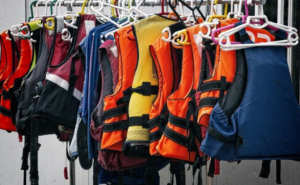
Carry a properly fitted, U.S. Coast Guard-approved life jacket for everyone aboard, sized for each person, especially children. Inflatable jackets can be comfortable enough for regular wear, which matters when conditions change quickly.
3. Fog horn and signaling kit
In fog, a horn helps other boats know you are there. Keep a working horn within reach of the helm, and attach a whistle to each life jacket so someone in the water can signal for help.
4. Spot light.

It’s very dark out there at night. a good spot light is essential for night time navigating. I have a rechargable one in my boat at all times. Most buoys and day markers have reflective tape affixed to them. while navigating at night your required lookout should be scanning the surface of the water to locate the next channel marker, making sure that any other boater coming towards you is not “blinded” by your spotlite.
One last word
South Jersey is home water for a lot of us. This summer showed how quickly an ordinary evening run can turn into a courtroom and a funeral: a marker, low visibility, and an operator who should not have been at the helm.
Slow down when you cannot see. Know where the markers are before they are in front of you. Put the jackets on, and let the skipper skip the drinks.
We will keep following these cases as they develop. Our thoughts are with the Pearson, Golabek, and Bereheiko families.